Programme Background
As part of our general, ongoing management of our 300+ mile railway network, we carry out regular inspections of adjacent vegetation. Ongoing management of lineside trees, shrubs, and plants is vital to maintaining high safety standards for passengers and railway employees.
We know it is important to do this in a planned and sensitive manner in order to minimise the impact on our neighbours and surrounding natural habitats. We take steps to strike a balance between safety and ensuring that we maintain Northern Ireland’s rich biodiversity. Experts have undertaken extensive surveys to assess the risk posed by trees and vegetation aligning the railway, and those identified are managed in line with industry standards and best practice.
Every tree identified is subject to a thorough ecological survey, undertaken by experienced ecologists, ensuring that there is no risk of mortality or injury to species such as bats , badgers, and birds, as well as no spread of invasive species, such as Japanese Knotweed.
The works are generally planned to be completed before and after bird nesting season, however, where this is not possible, we seek independent advice from ecologists to ensure that the works are completed without risk.
Impact of the Work
Due to proximity to the railway, for safety reasons, work will generally be undertaken at night. This means passenger journeys will not be affected.
We will work closely with specialised contractors to complete this essential work as quickly as possible and ensure that all necessary noise mitigation measures are implemented to keep disturbance to railway neighbours to a minimum.
We are currently working in the Magheramorne area, with work scheduled for the Limavady, Derry~Londonderry, and greater Belfast areas in the weeks ahead. Railway neighbours and stakeholders will be advised as required.
Translink and Biodiversity
Translink is committed to protecting and enhancing the natural environment and has a Climate Positive and Biodiversity strategy in place which will protect biodiversity across our network.
It is anticipated that the Tree Management Programme will lead to a degree of natural regeneration along the railway corridor once work has concluded, including grassland and hedgerow and scrub species.
We are also delivering a range of environmental offsetting projects, including the planting of thousands of new trees in dedicated woodland areas.
As part of our ongoing commitment to biodiversity, Translink has planted in excess of 25,000 native trees, with species including silver birch, rowan, cherry, hazel, and oak. We have taken independent advice to ensure that biodiversity is fully protected.
Working in partnership with local schools and councils, we look forward to continuing to support a range of community biodiversity projects, including the planting of trees and wildflowers, as part of our continued drive to look after nature and protect and maintain our local environment.
Project Update
Work is being undertaken in the Dark Arches area of Newtownabbey and on the Bangor Line between Holywood and Craigavad during the late winter and early spring of 2026. Residents in the vicinity of the works and the compound sites have been notified, and direct contact will be made with property-owners as necessary.
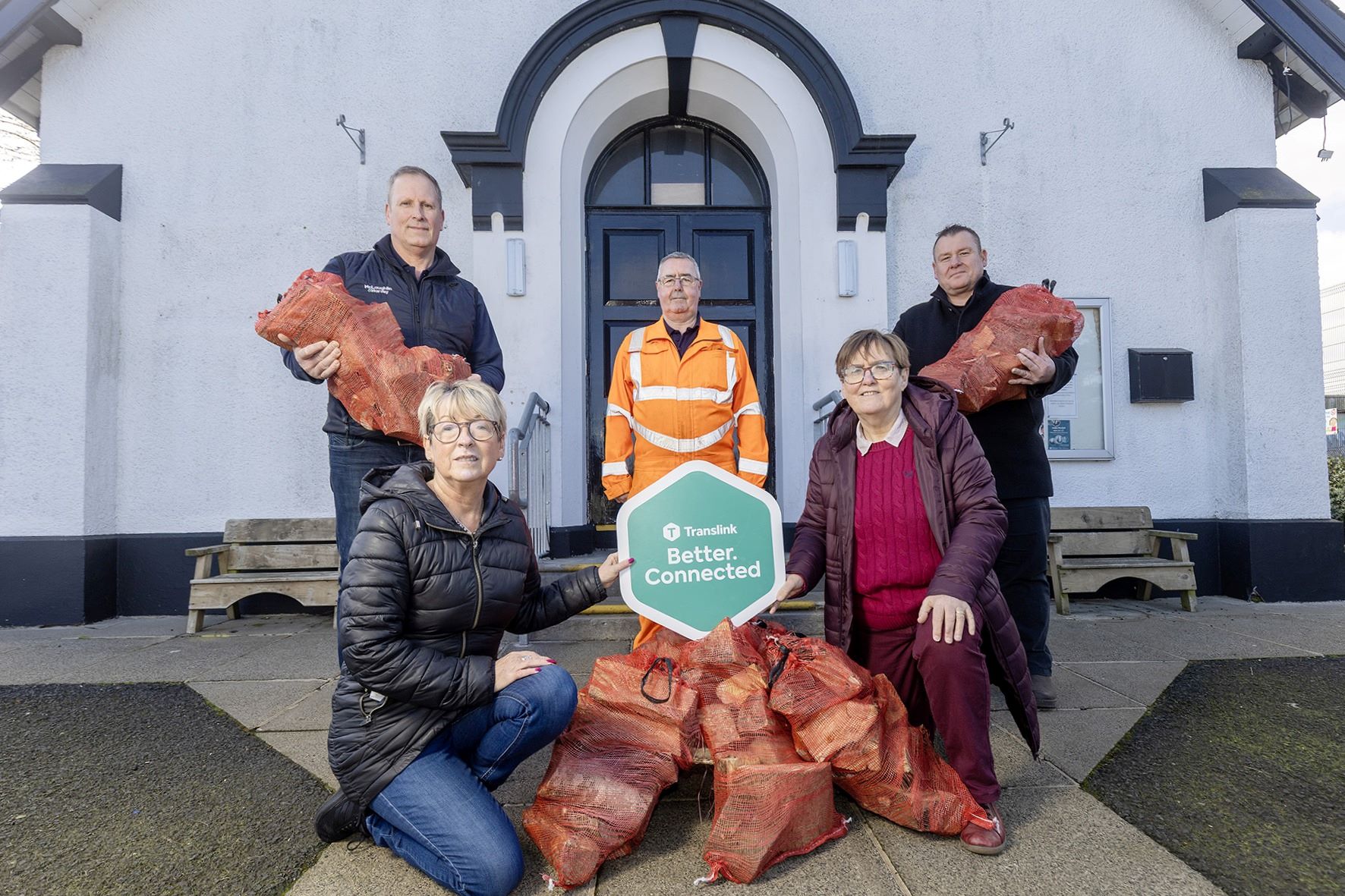
Translink Donates Firewood to Magheramorne and Glynn Community
Following the completion of essential tree management works close to Magheramorne on the Larne Line during late 2025, we were pleased to be able to donate approximately 100 bags of firewood, consisting of recovered material from the works, for community distribution and use.